20 20 words associate with the general term of Science. terms
Hi Mr. Alves Mesquita, so there's my glossary of 20 terms on the topic of sciences. I chose this subject because science has fascinated me since I was young. Already young, I already asked a lot of questions about the surrounding environment, about why these things are these things and how it works etc. Currently, I am in Tremplin Dec to lighten my session, but I will be going to Pure and applied science in the fall. The funny thing about my subject is that all areas of life and issues these days are directly related to science! To find the terms, I thought about the words that came to mind when I thought of science. After that, I researched the definitions given on the internet, sometimes improving them. I will carry you in the universe of sciences!
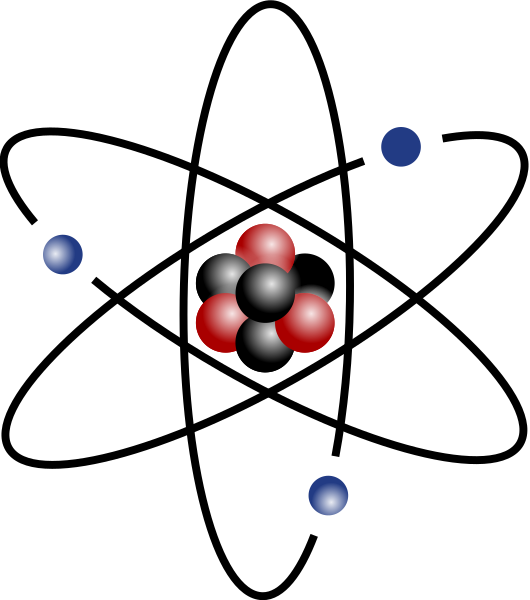
Atom
Noun
The basic unit of a chemical element.
Example: This is an Oxygen atom.
fr: Atome
Biology
Noun
Biology is the science of living things. It covers part of the natural sciences and the natural history of living beings.
Example: The biology of the human body.
fr: La biologie
Chemicals
Noun
A compound or substance that has been purified or prepared, especially artificially.
Example: Never mix too many chemicals together.
fr: Produits chimiques
Chemistry
Noun
Chemistry is a science of nature which studies matter and its transformations, and more precisely: chemical elements in the free state, atoms or atomic ions.
Example: This is how the chemistry of solutions works.
fr: La chimie
Cosmology
Noun
Science of the physical laws of the Universe, of its formation.
Example: Cosmology is used to understand where our world comes from.
fr: Cosmologie
Deoxyribonucleic Acid (DNA)
Noun
A self-replicating material that is present in nearly all living organisms as the main constituent of chromosomes. It is the carrier of genetic information.
Example: This student blew up the cell and released the DNA.
fr: Acide désoxyribonucléique (ADN)
Energy
Noun
Power derived from the utilization of physical or chemical resources.
Example: This chemical reaction releases a lot of energy.
fr: énergie
Experimentation
Noun
Scientific method based on experience and controlled observation to verify hypotheses.
Example: This experimentation is hard to accomplish.
fr: Expérimentation
Force
Noun
In physics, a force is any interaction that, when unopposed, will change the motion of an object. A force can cause an object with mass to change its velocity (which includes to begin moving from a state of rest), i.e., to accelerate.
Example: There is a lot of force that is exerted on the plane.
fr: Force
Hypothesis
Noun
A hypothesis is a proposition or a "saying" or an explanation that one is content to state without taking a position on its truthfulness, that is to say without affirming or denying it. It is therefore a simple assumption used in science.
Example: My hypothesis turned out to be correct!
fr: Hypothèse
Mathematics
Noun
Mathematics is the science that studies the relationships between abstract objects through logical and deductive reasoning.
Example: Mathematics is useful for finding new things in science.
fr: Les mathématiques
Medicine
Noun
Medicine, in the practical sense, is the science bearing witness to the organization of the human body, its normal functioning, and seeking to preserve health through the prevention and treatment of diseases.
Example: He studies medicine to become a doctor.
fr: Médecine
Molecule
Noun
A molecule is a grouping of two or more atoms that are joined by chemical bonds. A chemical bond is called a sharing or an exchange of electrons.
Example: The water molecule is very important for living beings.
fr: Molécule
Nuclear
Adjective
The term nuclear comes from the Latin nucleus which means nucleus. Considered as an adjective, it means “relative to the core”.
Example: Albert Einstein discovered a relationship that led to the creation of nuclear weapons.
fr: Nucléaire
Physics
Noun
Physics is the natural science that studies matter, its motion and behavior through space and time, and the related entities of energy and force.
Example: We are learning mechanical physics.
fr: La physique
Psychology
Noun
Psychology, is a scientific discipline that is interested in the study of the body of knowledge about psychic facts, behaviors and mental processes.
Example: Psychology saves lives every day.
fr: Psychologie
Scientist
Noun
A scientist is a person who devotes himself to the study of science or sciences with rigor and scientific methods.
Example: This scientist is known of all.
fr: Scientifique
Speed
Noun
Speed is a quantity which measures the ratio of an evolution to time.
Example: This rocket shattered the speed record for humans.
fr: Vitesse
Technologies
Noun
Technology is the study of tools and techniques. It is made by scientific advances.
Example: Today's technologies are everywhere!
fr: Les technologies
Universe
Noun
The Universe is all that exists, governed by a number of laws. Cosmology seeks to apprehend the Universe from a scientific point of view, like all the matter distributed in space-time.

:max_bytes(150000):strip_icc()/chemistry-glassware-56a12a083df78cf772680235.jpg)